

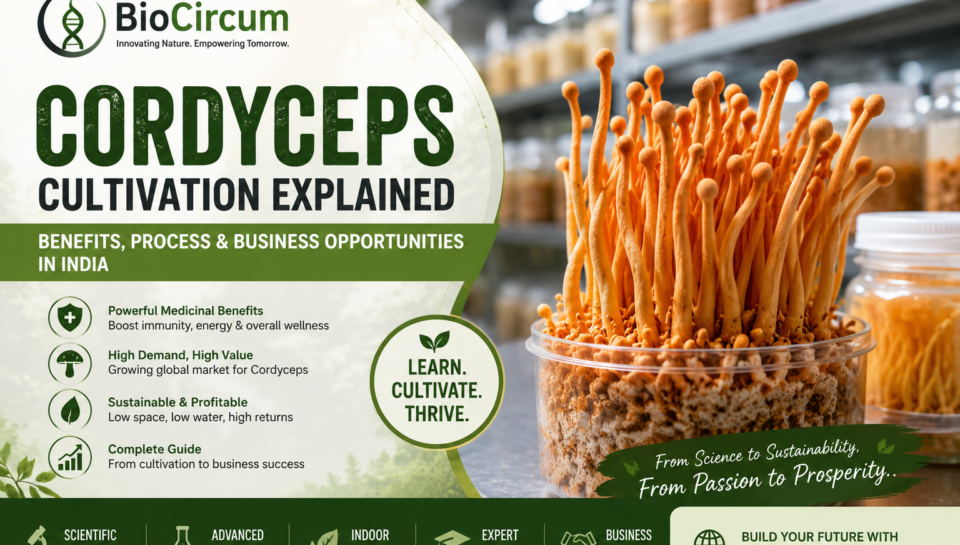
Once found only in the high-altitude regions of the Himalayas and Tibetan Plateau, Cordyceps has long been prized as one of the most powerful medicinal fungi in traditional medicine. Today, thanks to advances in biotechnology, Cordyceps farming no longer requires mountain expeditions or rare wild harvests. It can be cultivated indoors, under controlled conditions, making it one of the most exciting opportunities in India’s growing agri-biotech sector.
This guide covers everything you need to know about Cordyceps — from its origins and health benefits to the cultivation process, equipment, market potential, and how to avoid common beginner mistakes.
What is Cordyceps?
Cordyceps is a genus of parasitic fungi best known for two species: Cordyceps sinensis (the traditional wild variety that grows on caterpillar larvae) and Cordyceps militaris (the cultivated variety widely grown today for commercial and medicinal use).
While Cordyceps sinensis is rare, expensive, and difficult to harvest sustainably, Cordyceps militaris offers nearly identical bioactive compounds — including cordycepin and adenosine — and can be grown reliably on grain-based substrates indoors. This makes it the preferred species for Cordyceps cultivation businesses worldwide, including in India.
History of Cordyceps
Cordyceps has been used in Traditional Chinese Medicine (TCM) and Tibetan medicine for centuries, originally reserved for royalty and the elite due to its scarcity. Wild Cordyceps was historically hand-harvested from high-altitude meadows in Tibet, Nepal, and Bhutan, where it commanded prices higher than gold by weight.
As global demand grew and wild populations became unsustainable to harvest, researchers in China developed methods to cultivate Cordyceps militaris in laboratory and indoor farm settings during the late 20th century. This breakthrough made the Cordyceps mushroom accessible to a much wider market, paving the way for today’s structured, science-backed cultivation industry.
Health & Wellness Applications
Cordyceps is classified as one of the most researched medicinal mushrooms, valued for a range of potential health benefits, including:
- Energy & Stamina Support – Traditionally used to combat fatigue and improve physical endurance
- Immune System Support – Contains polysaccharides believed to support immune function
- Respiratory Health – Historically used to support lung function and respiratory conditions
- Antioxidant Properties – Rich in compounds that help combat oxidative stress
- Sexual Health & Vitality – Long associated with traditional use for stamina and vitality
This growing body of interest has fueled demand across supplement brands, wellness startups, nutraceutical companies, and functional food producers — all seeking reliable, high-quality Cordyceps supply chains.
How Cordyceps is Cultivated
Cordyceps cultivation follows a structured, lab-supported process:
- Strain Selection – Choosing a high-quality, disease-free Cordyceps militaris strain
- Substrate Preparation – Typically a mix of grains (like rice or wheat) enriched with nutrients
- Sterilization – Substrate is sterilized to eliminate contaminants before inoculation
- Inoculation – Cordyceps spawn is introduced to the sterilized substrate under sterile lab conditions
- Incubation – Jars or bottles are kept in the dark at controlled temperatures to allow mycelium colonization
- Fruiting Stage – Once colonized, substrates are moved to a fruiting environment with specific light, humidity, and temperature to trigger the growth of the orange fruiting bodies
- Harvesting – Mature fruiting bodies are harvested, dried, and processed for sale or extraction
Each stage requires precision, as contamination or incorrect environmental conditions can significantly reduce yield quality.
Indoor Farming Techniques
Indoor mushroom farming is what makes Cordyceps cultivation commercially viable at scale. Unlike field-based agriculture, indoor systems allow growers to precisely control:
- Temperature – Typically maintained between 18–22°C during fruiting
- Humidity – Kept between 85–95% to support fruiting body development
- Light Cycles – Specific light exposure (often LED-based) is required to trigger and support fruiting
- Air Circulation – Fresh air exchange is essential to prevent CO2 buildup and contamination
Because Cordyceps doesn’t require soil or large outdoor space, it’s an ideal crop for urban entrepreneurs, small facility owners, and agri-startups looking to enter high-value farming without needing acres of land.
Equipment Required
Setting up a Cordyceps cultivation unit typically requires:
- Autoclave or Pressure Sterilizer – For sterilizing substrate and equipment
- Laminar Flow Hood – To maintain a sterile environment during inoculation
- Incubation Chamber – Temperature-controlled space for mycelium growth
- Fruiting Chamber – A humidity- and light-controlled environment for fruiting body development
- Culture Jars/Bottles – For substrate and spawn
- Hygrometers & Thermometers – To monitor environmental conditions
- HEPA Filters – To maintain clean air and reduce contamination risk
While the initial setup requires investment, it can be scaled based on budget — from a small home-lab setup to a full commercial facility.
Market Demand
Global demand for Cordyceps has been rising steadily, driven by the wellness and nutraceutical industries. In India specifically, growing awareness of immunity-boosting and adaptogenic supplements has created strong interest from:
- Ayurvedic and wellness brands looking for natural, science-backed ingredients
- Supplement manufacturers seeking domestic sourcing to reduce import dependency
- Health-conscious consumers interested in functional mushroom powders, capsules, and extracts
- Export markets, where dried Cordyceps and extracts command premium prices
As India’s nutraceutical sector expands, domestically cultivated Cordyceps presents a strong opportunity to meet rising demand while reducing reliance on imported raw material.
Investment & Profit Potential
A Cordyceps business can be started at varying scales:
- Small-Scale Setup – A basic lab and fruiting chamber setup can be started with a modest investment, suitable for testing the market or supplying local wellness brands
- Medium-Scale Commercial Unit – Involves more controlled infrastructure and higher output, targeting supplement manufacturers and regional distributors
- Large-Scale Facility – Designed for export-quality production, often integrated with extraction and processing capabilities
Because Cordyceps sells at a significantly higher price point per kilogram compared to most agricultural produce, profit margins can be attractive — provided quality, consistency, and contamination control are maintained throughout production.
Common Mistakes Beginners Make
Many first-time growers face setbacks due to avoidable errors, including:
- Skipping Proper Sterilization – Leading to contamination and failed batches
- Inconsistent Environmental Control – Fluctuating temperature or humidity disrupts fruiting
- Using Low-Quality Strains – Poor strain selection results in weak yields and inconsistent potency
- Underestimating Lead Time – Cordyceps cultivation takes weeks from inoculation to harvest; rushing the process often reduces quality
- Lack of Market Research – Producing without securing buyers or understanding pricing can lead to unsold inventory
Most of these mistakes stem from a lack of structured training and hands-on experience — which is why proper guidance is critical before scaling up.
Why Training Matters
Cordyceps cultivation blends biology, lab hygiene, and environmental engineering — it isn’t something that can be reliably learned through trial and error alone. Structured training helps beginners:
- Understand strain selection and substrate formulation
- Master sterile inoculation techniques to avoid contamination
- Set up and manage incubation and fruiting environments correctly
- Build a realistic business and pricing model based on market data
- Avoid costly early-stage mistakes that can derail an entire cultivation cycle
With the right training, aspiring cultivators can move from experimentation to consistent, commercially viable production much faster.
Start Your Cordyceps Cultivation Journey
Cordyceps farming sits at a unique intersection of traditional medicine, modern biotechnology, and growing consumer demand — making it one of the most promising opportunities in India’s indoor farming space today.
Join BioCircum’s Cordyceps Indoor Farming Training and start your cultivation journey with expert guidance, hands-on learning, and a clear path to building a successful Cordyceps business.